
RPA + AI-Assisted Automation
Robots plus models for documents, classification, and exception routing — with human review where the model is not sure.
Talk to an expert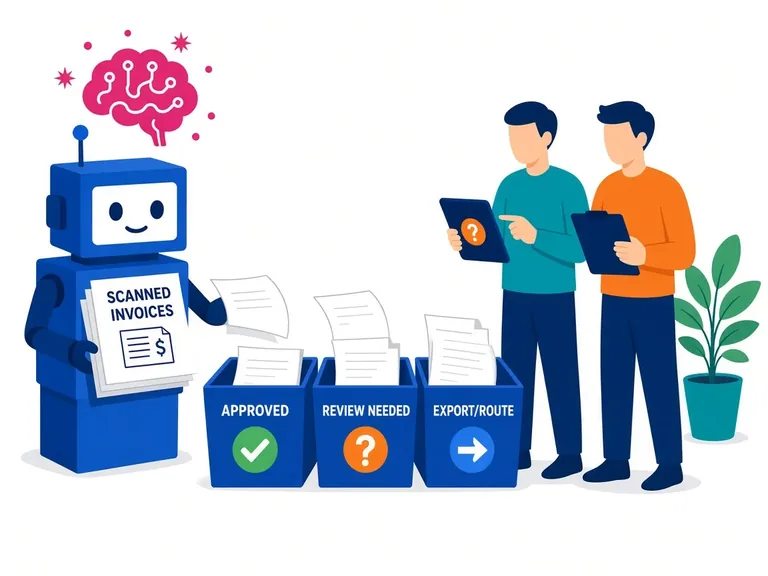
The offering
What we actually deliver
Classic RPA breaks on unstructured input: invoices in mixed layouts, emails, scanned forms. Combining a robot with a model — OCR, classification, extraction — is useful when the volume is high and the cost of a wrong extract is bounded. We design the human-in-the-loop first: what confidence sends a record to a person, and how that person corrects it so the flow still completes.
The robot remains the hands (login, paste, submit). The model is the eyes. We do not let a model post a payment without the same controls you would give a junior clerk. Prompts, models, and extraction schemas are versioned. Evaluation sets are kept so a model upgrade is a measured change, not a hope.
Data handling is explicit. Documents may be PII or financial. We use private endpoints or on-prem extractors when residency requires it. Logs capture enough to debug without storing full payloads longer than policy allows.
You get a production path that is faster than pure keying, with exception queues that staff actually work. If extraction quality is not there, we say so and keep the process manual rather than ship a confident wrong bot. Throughput, exception mix, and cost per document are reviewed on a cadence so a model upgrade is a measured change, not an overnight swap that quietly degrades finance or shared services.
What you get
How we work
A delivery path you can follow
Each engagement is sequenced so architecture, cutover, and handover are visible — not a black box at the end.
Talk to us about RPA + AI-Assisted Automation
Share the current estate, deadline, and constraints — we will tell you what a first engagement should contain.